How to grow your YouTube channel: a practical playbook
A growth playbook for small and mid-size channels: pick a viewer, find proven ideas, package and hold attention, then use Shorts, analytics and collabs.

11 min read
Most growth advice is written for big channels. "Chase trends" and "go after big keywords" work better with a large audience behind you. This playbook is for channels with a few hundred to a few hundred thousand subscribers. Each step points to YouTube's own documentation or a method you can check, and links to a deeper post.
What actually makes a YouTube channel grow?
YouTube decides who sees your videos. Its page on how recommendations work says the system looks at a viewer's "viewing behaviour, likes, dislikes, subscriptions and feedback", including satisfaction surveys, and at the reputation and quality of a channel.
In practice that means two jobs, on every video:
- Get the right people to click. That's the idea and the packaging.
- Make them glad they did. That's the video itself, and especially how long people keep watching.
Step 1: Who is your channel for?
Pick one viewer you can describe in a sentence: "beginner home cooks in India who cook for one", not "food lovers". A clear viewer makes every other decision easier. You know which topics to cover, which words go in the title and which channels to learn from.
A niche is a person with a problem or interest that keeps coming back. If you can name ten videos that person would want this month, it's wide enough.
Step 2: Where do good video ideas come from?
From videos that already worked for an audience like yours. The most useful signal is an outlier: a video that got far more views than its own channel usually gets at the same age. 2× the usual is clearly above normal. 5× or more is a breakout.
Build a list of 10 to 20 channels in your niche, including some your size, and look for their outliers. Here's what that looks like on one travel channel:
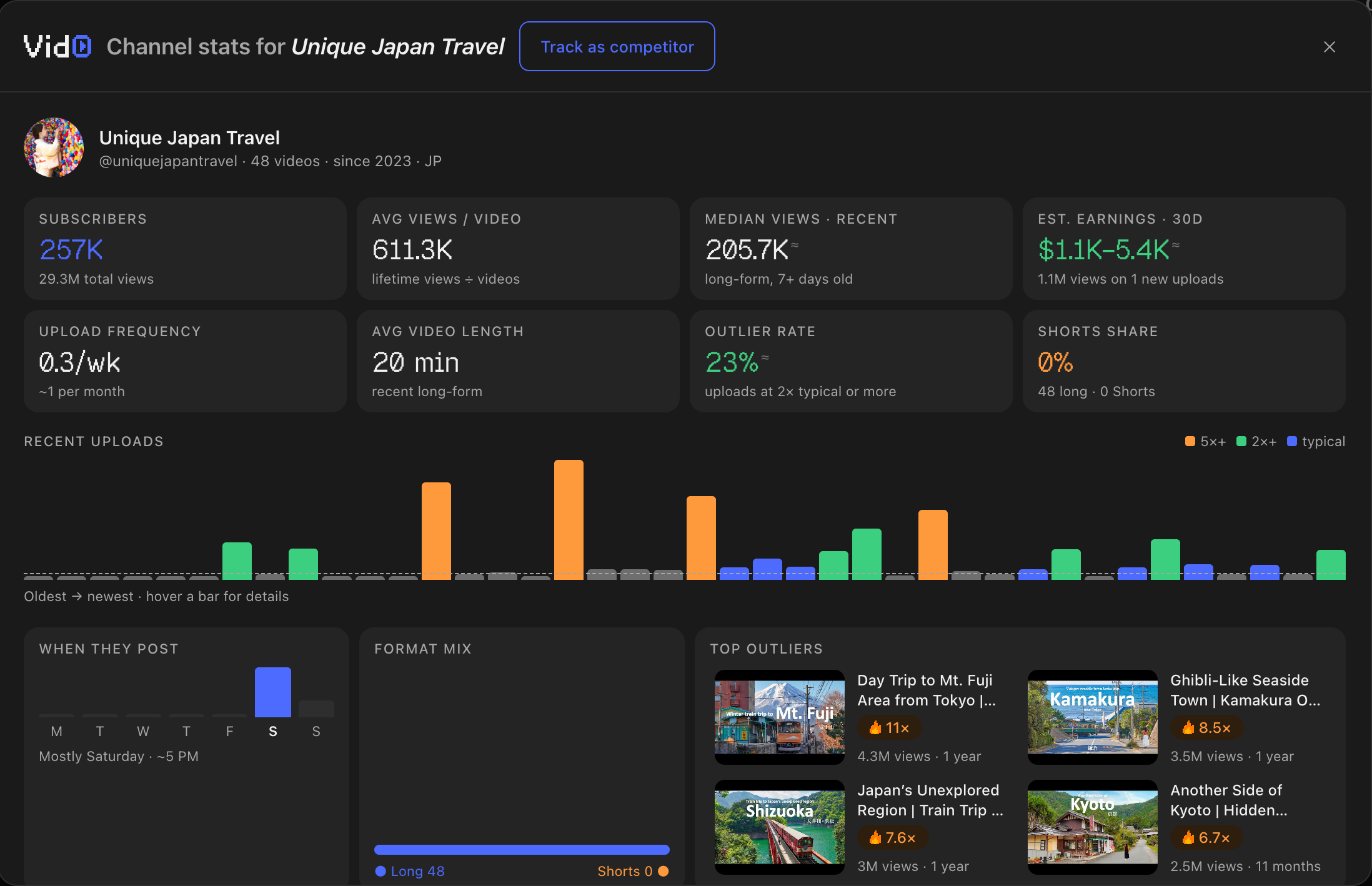
The lesson here isn't "make a Mt. Fuji video". It's that a trip to one named place beats this channel's normal again and again. That's a repeatable format. For each outlier, ask whether the topic, the format or the packaging made the difference. The full method is in how to find outlier videos on YouTube, and the maths behind it is in what a YouTube outlier score is.
Step 3: Can a channel your size win this topic?
A good idea in a crowded search result can still go nowhere for a small channel. Before you film, search the main keyword on YouTube and look at who ranks. If every top result is from a channel with a hundred times your subscribers, pick a narrower version of the topic.
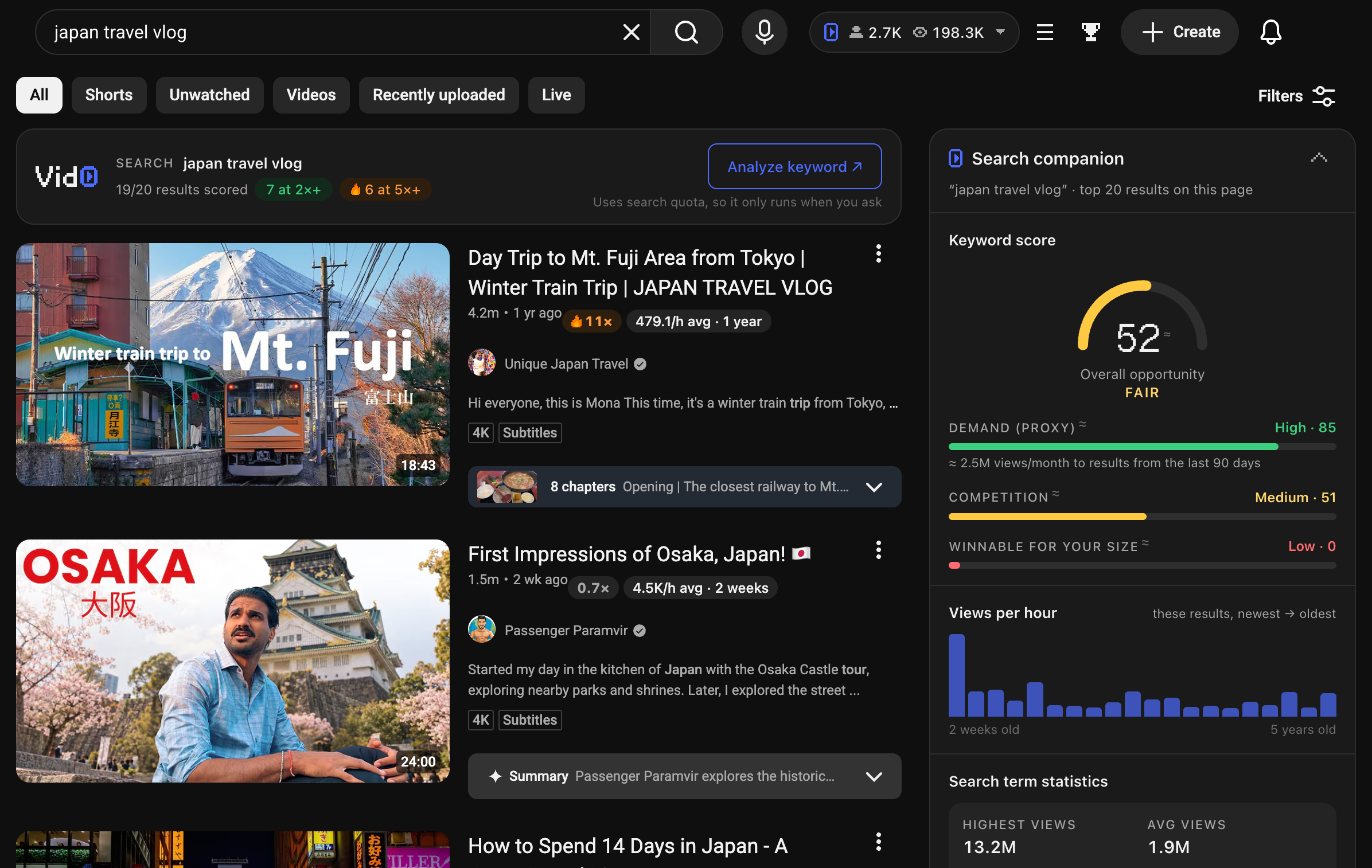
Vid0 scores this as Winnable: the share of the top results that come from channels with at most 3× your subscribers and that beat their own usual views. High demand with low Winnable is a trap. Medium demand with high Winnable is where small channels grow. Here's the full method: YouTube keyword research for small channels.
Step 4: How do you package a video so people click?
Your title and thumbnail are the only parts of the video most people ever see. Write them before you film, so the video delivers on a promise you've already made.
- Make one clear, specific promise. Numbers, names, places and timeframes make it believable.
- Leave one question open that only the video answers.
- Front-load it. Put the payoff and the searched words in the first 40 or so characters, where phones cut titles off.
- Keep the thumbnail to one idea that adds to the title rather than repeating it.
The six-point checklist with examples is in how to write YouTube titles that get clicked, and the free YouTube title checker checks length and the first 40 characters as you type. The description and tags matter less, but they still help search: here's a YouTube description template with a scoring checklist and how to see the tags on any YouTube video. The free YouTube tag extractor shows the tags on any public video.
Then measure. YouTube's Help page on impressions and click-through rate says half of all channels and videos have an impressions CTR between 2% and 10%. It also warns that clickbait tends to show a high CTR with low average view duration. YouTube's built-in A/B test for titles and thumbnails lets you test up to three versions on a long-form video, and picks the winner by watch time, not clicks. That tells you what YouTube values: the click only counts if people stay.
Step 5: How do you keep viewers watching?
The first 30 seconds decide most of it. YouTube Studio's key moments for audience retention report has an Intro figure: the percentage of viewers still watching after the first 30 seconds. YouTube's advice for improving it is to make the thumbnail and title match the content and to experiment with the opening.
A simple structure for the first 30 seconds:
- Confirm the promise. Show or say the thing the title promised, straight away.
- Show what's coming. One line on what they'll get by the end.
- Start. Skip the long greeting, the channel intro and the "before we begin".
Then look at the rest of the retention graph. The same report marks top moments (almost nobody left), spikes (rewatched or shared) and dips (people skipped or left). Move strong material earlier, and cut or tighten what sits before a dip. Chapters help viewers find their part instead of leaving.
Step 6: How often should you upload?
As often as you can without the videos getting worse. The channel in Step 2 uploads about once a month, has 257K subscribers and still breaks out regularly. Frequency isn't what holds it back.
What matters more than frequency:
- A pace you can keep for a year. One good video a week, or every two weeks, beats a month of daily uploads followed by silence.
- A rhythm your viewers can learn. A regular day helps returning viewers know when to look.
- Your own best time. Generic "best time to post" charts average millions of channels. Find yours from your own uploads: the best time to post on YouTube is your time.
Big channels back this up. Among the 246 large channels Vid0 tracks, the number of uploads had almost no relationship with subscriber count. The numbers are in what the biggest YouTube channels have in common.
Step 7: Should you make Shorts or long-form videos?
They do different jobs. YouTube's Shorts guide describes Shorts as vertical videos up to 3 minutes long. They're good for reach and for testing ideas fast. Long-form is where sponsored integrations usually run, and, by Vid0's estimates below, where each view earns more from ads.
Three things to keep in mind:
- Compare like with like. Shorts views and long-form views behave differently, so judge a Short against your other Shorts. Vid0 scores them separately for this reason.
- They count separately for monetization. YouTube's Partner Program page says watch hours from Shorts views in the Shorts feed don't count toward the 4,000 watch-hour path.
- They usually earn less per view. Vid0's rough earnings estimate assumes $1 to $5 per 1,000 long-form views and $0.03 to $0.08 per 1,000 Shorts views. Those are Vid0 estimates, not YouTube data, and real rates vary a lot by niche and country.
A simple split to try: long-form as the core, and Shorts made from the best moments of each long video, with a pointer to the full one.
Step 8: How do you read your analytics and improve?
Open YouTube Studio Analytics once a week and look at three things for each recent video:
| Metric | What it tells you | YouTube's guide |
|---|---|---|
| Impressions click-through rate | Whether the packaging works for the people who see it | Impressions and CTR |
| Audience retention and the Intro figure | Whether the video keeps the promise | Key moments for retention |
| Traffic sources | Where viewers found you: YouTube search, browse features (Home and subscriptions), suggested videos, Shorts, external sources | Traffic sources |
Scroll sideways to see every column.
The traffic source mix tells you what to fix. Mostly search? Titles and keywords matter most. Mostly suggested videos? Study the videos you're being suggested next to.
Judge each video against your own usual, not against other channels. Vid0's forecast check-in in YouTube Studio does this for a new upload:
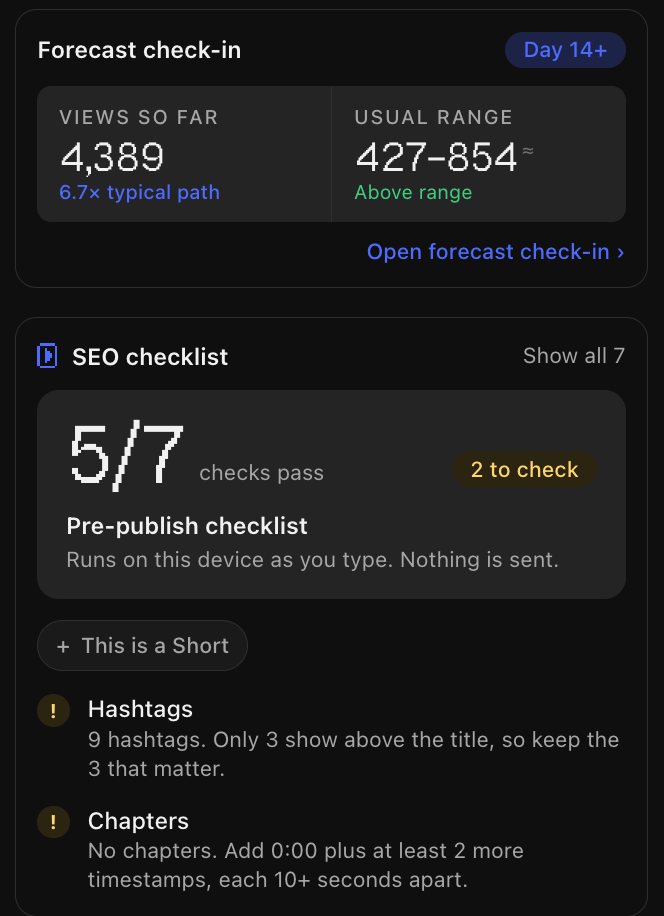
When a video beats your usual, ask what made the difference (topic, format or packaging) and make another one on purpose.
Step 9: Do collaborations and community help you grow?
Yes, when the audiences overlap. YouTube's Collaborations feature lets you invite other creators as collaborators on a video. YouTube says its goal is to recommend that video to the audiences of both channels, though changes in search and recommendations may not show at first. Revenue stays with the channel that posted it.
Collab with channels a little bigger or about your size whose viewers would like your videos. The outlier list from Step 2 is a good place to find them.
For community, reply to comments in the first day and turn good comments into future videos.
Step 10: When can you start making money from your channel?
There are two thresholds in the YouTube Partner Program, as of October 2026. Both come from YouTube Help: the expanded Partner Program overview and the Partner Program eligibility page.
| Tier | Requirements | What it unlocks |
|---|---|---|
| Expanded YPP (in eligible countries, India included) | 500 subscribers and 3 valid public uploads in the last 90 days, plus 3,000 qualified watch hours in the last 12 months or 3 million qualified Shorts views in the last 90 days | Fan funding (channel memberships, Super Chat, Super Stickers, Super Thanks) and Shopping |
| Full YPP | 1,000 subscribers plus 4,000 qualified watch hours in the last 12 months or 10 million qualified Shorts views in the last 90 days | Ad revenue sharing and YouTube Premium revenue |
Scroll sideways to see every column.
You'll also need to follow YouTube's monetization policies, have no active Community Guidelines strikes, turn on 2-Step Verification and link an AdSense account. YouTube's eligibility page also says it is introducing updates to the program from February 1, 2027, so check that page for the current terms before you apply.
You don't have to wait for any of it to earn from sponsors. Brands pay for steady views from a clear audience, not a subscriber milestone. Start here:
- How to get your first YouTube sponsorship
- How much to charge for a YouTube sponsorship
- What to put in a YouTube media kit
A free Vid0 creator page drafts that media kit from your public stats, with suggested prices you can edit, and the free YouTube sponsorship rate calculator works out a price range from your typical views. If you're in India, how much Indian YouTubers earn per 1,000 views explains why ad revenue per view is lower there, and why sponsorships matter more.
A weekly routine that puts it together
- Monday: check your competitors' outliers from the last week and save two or three ideas.
- Before filming: check the keyword is winnable at your size, then write the title and thumbnail.
- Filming: script the first 30 seconds properly.
- After publishing: reply to comments in the first day.
- Next Monday: check CTR, the Intro figure and traffic sources on last week's upload against your usual, and write down one thing to change.
The Vid0 Chrome extension puts most of this on YouTube itself: outlier badges on search results, a keyword score beside them, channel stats on every channel page and checks inside YouTube Studio. Here are seven ways to use the extension every week.
If you're picking a research tool, vidIQ vs TubeBuddy vs Vid0 compares the three for small channels, and 10 vidIQ alternatives compared covers the wider field. To see where the biggest channels in your country or category sit, the most subscribed YouTube channels rankings are free.
FAQ
How long does it take to grow a YouTube channel?
There's no set timeline. Channels that grow steadily tend to have a clear viewer, a pace they can keep and a habit of studying what worked. Judge progress by whether your typical views are rising over months, not by any single video.
How many subscribers do you need to make money on YouTube?
In eligible countries, the expanded Partner Program starts at 500 subscribers (with uploads and watch hours or Shorts views) and unlocks fan funding. Ad revenue sharing needs 1,000 subscribers plus 4,000 watch hours or 10 million Shorts views. Sponsorships have no fixed threshold.
Should a new channel post Shorts?
Shorts are a fast way to test ideas and reach new viewers. Most creators keep long-form as the core, because long-form drives watch time and sponsorships, and use Shorts to point people to it.
What is a good click-through rate on YouTube?
YouTube says half of all channels and videos have an impressions CTR between 2% and 10%. Compare a video's CTR with your own other videos and traffic sources rather than with a single target.
Is it better to upload more often or make better videos?
Better videos, at a pace you can keep. A channel that uploads once a month can grow if most videos are worth waiting for. Frequency helps only when quality holds.
What should I fix first if my channel isn't growing?
Look at your last ten videos. If CTR is low, work on ideas and packaging. If CTR is fine but viewers leave in the first 30 seconds, work on openings. If both are fine, test topics that broke out for channels your size.
Create your creator profile today
Your stats, rates and past collabs on one link, like vid0.in/@yourchannel. Share it with brands and get booked.
Keep reading
All posts →- AnalyticsGrowth
The best time to post on YouTube is your time: how to find it
Why generic "best time to post" charts mislead, and how to find the days and hours that work for your own channel from your past uploads.
4 min read
- PackagingAnalytics
What is a good CTR on YouTube? (And how to judge yours)
YouTube says half of channels and videos sit between 2% and 10% CTR. Why niche benchmarks don't hold up, and how to judge CTR against your own channel.
7 min read
- ComparisonsResearch
10 vidIQ alternatives compared (2026): free and paid
10 vidIQ alternatives compared on price, free plans and features, from Vid0 and TubeBuddy to 1of10, ViewStats and OutlierKit, with October 2026 prices.
13 min read
Find your next outlier
Vid0 shows which videos broke out in your niche, why they did, and what you could make next.