How to get your first YouTube sponsorship with under 10K subscribers
What brands look for in small channels, how to find the right ones, a pitch email you can copy, and how to price your first deal.

4 min read
Brands don't only sponsor big channels. Small channels with a focused audience are often cheaper per interested viewer, easier to work with and more trusted by their viewers. Here's how to go from zero to your first deal.
When do brands start caring about a small channel?
There's no subscriber number where sponsorships switch on. What brands look for is:
- Steady views: your typical video gets a predictable number of views, even if it's small.
- A clear audience: you can say exactly who watches ("beginner home cooks in India", not "everyone").
- Fit: your viewers are the brand's buyers.
- Consistency: you upload regularly, so their segment won't sit in a draft for months.
If you have those, a few thousand views a video is enough for many smaller brands, apps and online tools.
Step 1: Which brands should you pitch first?
Brands your viewers already buy from. Start with the products you use and mention in your videos. Then look at who sponsors channels a bit bigger than yours in your niche: those brands already pay for your audience. Aim for 20 names, mostly smaller companies, startups and tools rather than household names.
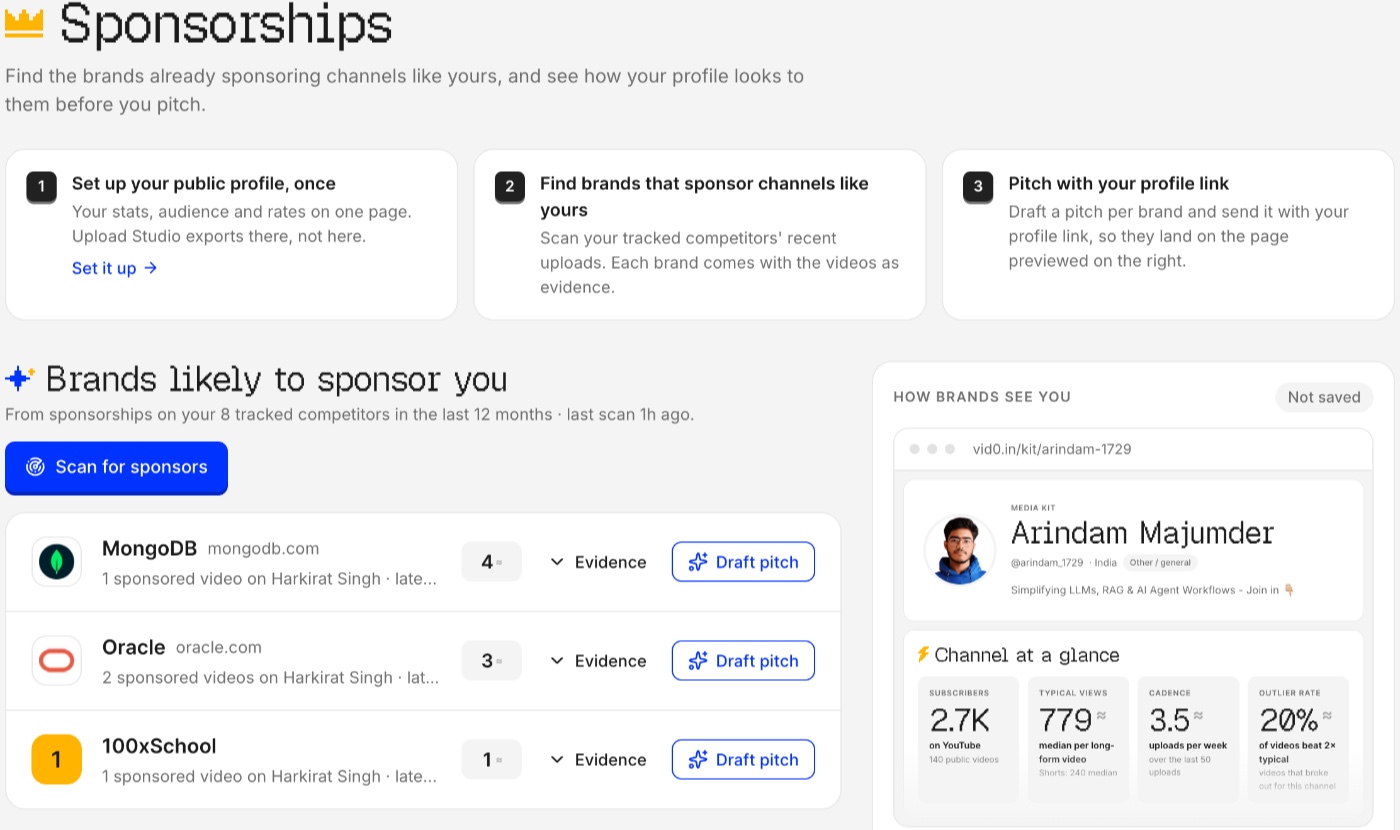
Vid0 does the second part for you. It scans the recent uploads of the channels you track for sponsored segments and lists the brands, with the videos as evidence:
Step 2: Build a one-page media kit
Your kit should show who you are, your typical views per video, your audience, what you offer with prices, and how to reach you. Here's what to put in a YouTube media kit. Vid0 can draft a free creator page from your channel that does this, with one link you can paste into emails.
Step 3: Price your first deal
Price from your typical views and your niche, not your subscriber count: brands pay for the people who will see the segment. The formula, a CPM band for each niche and worked examples are in how much to charge for a YouTube sponsorship.
For a first deal, quoting near the low end of that range is fine. Results from that deal are what let you charge more for the next one.
Step 4: How do you pitch a brand?
Send a short, specific email to the right person: a partnerships, marketing or creator lead, often on LinkedIn or the company's site. Keep it under 150 words.
Subject: A segment for [product] on [channel name]

Hi [name],

I make [what you make] for [who watches] on YouTube ([channel link]).
My videos usually get around [typical views] views, and my viewers
are mostly [audience detail].

I already use [product] for [real use], and I think a 60-second
segment showing [specific feature] would land well with them.
For example: [one-line idea for the segment].

My media kit, with prices and audience: [kit link]

Would you be open to a first collab this month?

[Your name]Step 5: What if a brand doesn't reply?
If there's no reply in a week, send one short follow-up. Then move to the next brand on your list. Expect most pitches to get no answer. That's normal, and it's why you start with 20.
Step 6: How do you turn a first deal into more?
Deliver on time, send the brand your video's numbers after a week or two, and ask if they'd like to go again. A brand that comes back is worth more than three new ones, and it's the best line you can add to your media kit.
Can brands come to you instead?
Yes. On Vid0, brands search for creators by audience fit and see your creator page with your prices. When one wants to work with you, the request goes through the Vid0 team, who makes the introduction. Your email is never shown to brands.
FAQ
How many subscribers do you need to get sponsored on YouTube?
There's no set number. Brands look at typical views, audience fit and consistency. Channels with a few thousand subscribers and steady views get sponsored, especially by smaller brands and online tools.
How do small YouTubers find sponsors?
Start with products you already use, then look at brands sponsoring slightly bigger channels in your niche. Send a short, specific pitch with a media kit link.
What should I charge for my first sponsorship?
Price from your typical views and your niche, not your subscriber count, and quote near the low end of your range for a first deal.
Should I accept free products instead of payment?
It can make sense for a product you'd genuinely use while you're starting, but be clear it's a one-off. Your time and your audience's trust are worth paying for.
Do I need to disclose sponsorships on YouTube?
Yes. YouTube requires you to tick the paid promotion box for sponsored content, and you should say it out loud in the video too. Rules in your country may add more.
Create your creator profile today
Your stats, rates and past collabs on one link, like vid0.in/@yourchannel. Share it with brands and get booked.
Keep reading
All posts →- GrowthResearch
How to grow your YouTube channel: a practical playbook
A growth playbook for small and mid-size channels: pick a viewer, find proven ideas, package and hold attention, then use Shorts, analytics and collabs.
11 min read
- ComparisonsPricing
vidIQ vs TubeBuddy vs Vid0: best for a small channel?
vidIQ, TubeBuddy and Vid0 compared for small YouTube channels, with October 2026 prices in USD and INR, a feature table and a verdict by use case.
7 min read
- Brand dealsPricing
How much to charge for a YouTube sponsorship (with the formula)
The formula Vid0 uses to price a YouTube integration from your typical views and your niche, with worked examples at 5K, 20K and 100K views.
6 min read
Find your next outlier
Vid0 shows which videos broke out in your niche, why they did, and what you could make next.