How much to charge for a YouTube sponsorship (with the formula)
The formula Vid0 uses to price a YouTube integration from your typical views and your niche, with worked examples at 5K, 20K and 100K views.

6 min read
Most creators guess their first rate, or copy a number they saw on Twitter from a channel ten times their size. Brands don't pay for subscribers. They pay for the people who will actually see their segment, so the honest starting point is how many views your videos get. Still looking for that first brand? Start with how to get your first YouTube sponsorship.
This is the exact method Vid0 uses to suggest rates on your free creator page. You can work it out by hand in five minutes, or put your numbers into the free YouTube sponsorship rate calculator.
What number should you start from?
Start from your typical views per long-form video, measured on videos that have had time to collect views.
Vid0 takes the median views of your long-form uploads that are at least 30 days old, from your 50 most recent uploads. The median ignores one-off hits, so a single viral video doesn't inflate your price (and then disappoint the brand). If fewer than three of your videos are 30 days old, it falls back to videos at least 7 days old and flags the result as a likely underestimate.
Shorts don't count towards this number. Shorts views behave very differently from long-form, and most integrations run in long-form videos.
Once you have it, the free YouTube sponsorship rate calculator turns it into a price range for your niche, or you can follow the steps below by hand.
What CPM should you use for your niche?
CPM here means what a brand pays for every 1,000 views of the integration. It varies a lot by niche, because some audiences are worth more to advertisers than others. These are the bands Vid0 uses:
| Niche | CPM band (USD) | Integration price at 10,000 typical views |
|---|---|---|
| Finance | $40 to $80 | $400 to $800 |
| Tech | $30 to $60 | $300 to $600 |
| Education | $20 to $45 | $200 to $450 |
| Lifestyle | $15 to $35 | $150 to $350 |
| Gaming | $10 to $25 | $100 to $250 |
| Other / general | $15 to $50 | $150 to $500 |
Scroll sideways to see every column.
These bands are Vid0's estimates, not data from YouTube or from any brand. Treat the low end as the price for a first deal or a brand you really want, and the high end as the price once you have proof the segment converts.
The formula, step by step
- Typical views: the median views of your long-form videos that are 30 or more days old.
- Integration price: typical views ÷ 1,000 × the low and high CPM for your niche. That gives you a range.
- Round it: Vid0 rounds to $5 steps under $100, $10 steps under $1,000 and $50 steps above.
- Other formats: multiply the integration range.
| Format | Multiplier on the integration price |
|---|---|
| Integration (a 60 to 90 second segment) | 1× |
| Dedicated video | 1.3× to 3× |
| YouTube Short | 0.3× to 0.6× |
Worked examples: a tech channel at 5K, 20K and 100K views
| Typical views | Integration | Dedicated video | Short |
|---|---|---|---|
| 5,000 | $150 to $300 | $200 to $900 | $45 to $180 |
| 20,000 | $600 to $1,200 | $780 to $3,600 | $180 to $720 |
| 100,000 | $3,000 to $6,000 | $3,900 to $18,000 | $900 to $3,600 |
Scroll sideways to see every column.
Here's the same formula on a real channel with 2.7K subscribers, in Vid0:
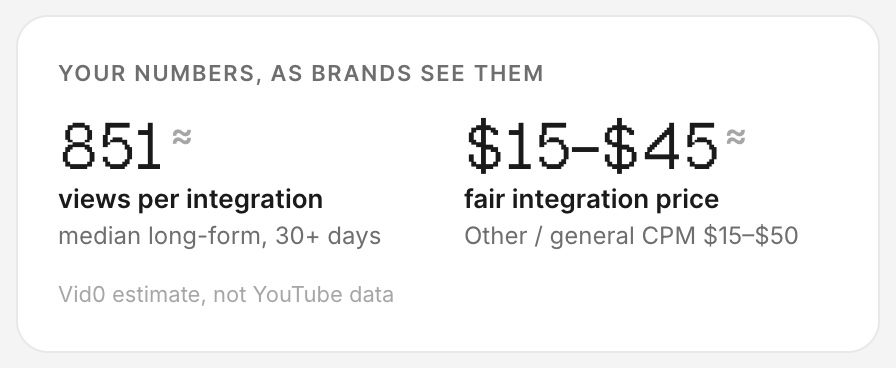
Take the 20,000-view row: 20,000 ÷ 1,000 = 20, and 20 × $30 = $600 and 20 × $60 = $1,200. A dedicated video stretches from $600 × 1.3 = $780 up to $1,200 × 3 = $3,600. The range is wide on purpose. Where you land inside it depends on the next section.
What moves your price up or down?
- Engagement and fit. A small audience that trusts you on one topic is worth more to a brand in that topic than a broad one.
- Proof. Past collabs, and especially results from them (sign-ups, sales, codes used), let you quote the top of the range.
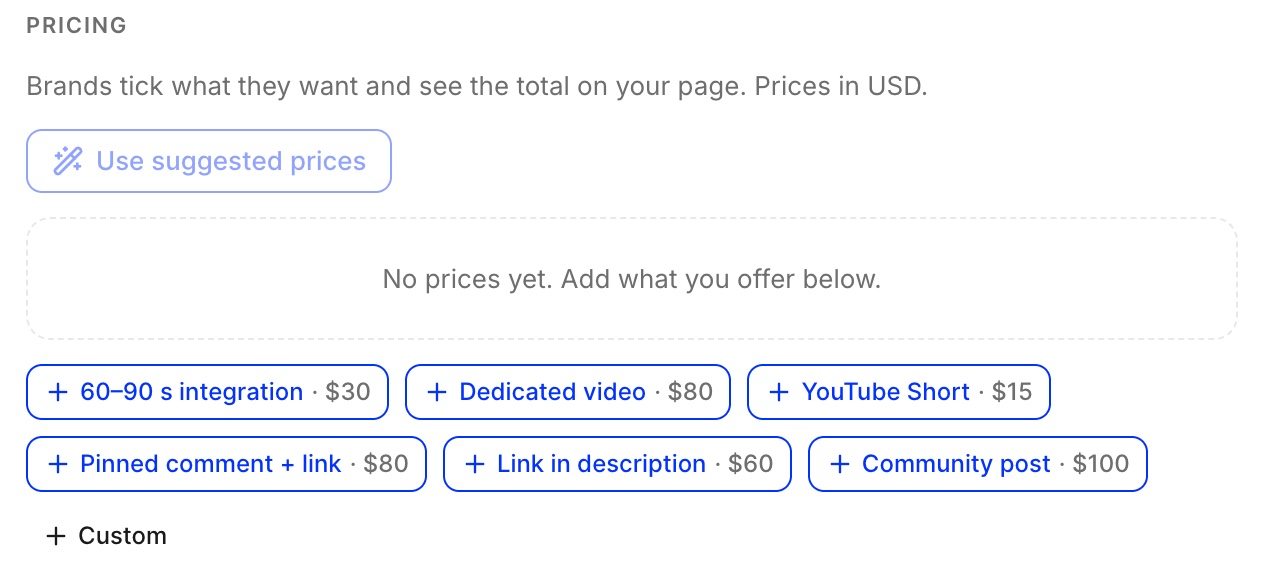
- Extras. Usage rights (the brand reusing your clip in ads), exclusivity (no competitors for a period), a pinned comment or a link in the description are all worth charging for separately. Vid0's editor starts you at $80 for a pinned comment with a link for 30 days, $60 for a link in the description for 30 days and $100 for a community post. Change them to suit you.
- Timing. Videos that keep getting views for months are worth more than ones that peak in a week. If your back catalogue keeps working, say so.
On a Vid0 creator page, each format starts at the middle of its estimated range, and the extras start at the fixed prices above. For the 2.7K-subscriber channel, that's $30 for an integration, $80 for a dedicated video and $15 for a Short:
How do you quote it to a brand?
Give a range for each format and let the brand pick. A list like "60 to 90 second integration: $600; dedicated video: $1,500; Short: $250" is easier to say yes to than an open "what's your budget?". Put the same list in your media kit: here's what to include in a YouTube media kit, section by section. On a Vid0 creator page, brands tick the items they want and see the total before they send a request.
FAQ
How much should a YouTuber with 10K subscribers charge?
It depends on views, not subscribers. If a 10K-subscriber tech channel's videos usually get 3,000 views, Vid0's formula suggests about $90 to $180 for an integration. If they usually get 10,000 views, it's about $300 to $600.
Is a dedicated video always more expensive than an integration?
Yes. A whole video about one brand takes more work and gives the brand more attention, so Vid0 prices it at 1.3 to 3 times the integration price.
How should I price YouTube Shorts sponsorships?
Vid0 prices a Short at 0.3 to 0.6 times the integration price, because Shorts views are cheaper for brands and harder to turn into clicks.
Should I use my average views or my median views?
Use the median. One viral video can double your average, and a brand that pays for that number and gets your usual views won't come back.
Do these rates include usage rights or exclusivity?
No. The formula prices the segment in your video. Charge separately for a brand reusing the clip in ads, or for not working with competitors for a set time.
Where can I get these numbers worked out for me?
Type your channel on the Vid0 creators page. It drafts a free creator page from your public stats, with suggested prices you can edit.
Create your creator profile today
Your stats, rates and past collabs on one link, like vid0.in/@yourchannel. Share it with brands and get booked.
Keep reading
All posts →- IndiaComparisons
The best YouTube tools for Indian creators (2026)
Free YouTube Studio tools plus vidIQ, TubeBuddy, Vid0, 1of10 and ViewStats compared for Indian creators, with rupee prices from each vendor's own page.
6 min read
- ComparisonsPricing
Best TubeBuddy alternatives in 2026
TubeBuddy alternatives compared on price, free plans and what they can change on your channel, from vidIQ and 1of10 to YouTube's own A/B tests and Vid0.
6 min read
- ComparisonsResearch
10 vidIQ alternatives compared (2026): free and paid
10 vidIQ alternatives compared on price, free plans and features, from Vid0 and TubeBuddy to 1of10, ViewStats and OutlierKit, with October 2026 prices.
13 min read
Find your next outlier
Vid0 shows which videos broke out in your niche, why they did, and what you could make next.