How to get your first 1,000 YouTube subscribers
Ten steps for new channels. Learn from channels your size, package before you film, win the first 30 seconds and judge every upload against your usual.

8 min read
The first 1,000 subscribers are the hardest. You have no audience, no data and no idea which videos will work, so most new channels guess: a new topic every week, a new style every month, a title written after the edit. The ones that make it treat their first year like research instead. These ten steps make that concrete.
1. Pick a viewer, not a category
"Tech" is a category. "Developers who want to ship side projects with AI" is a viewer. Write one sentence on who the channel is for, what they already know and what they keep searching for.
Then test it: can you list ten videos that person would want this month? If you get stuck at four, widen it. If anyone at all could watch it, narrow it.
2. Study channels your size, not the giants
Big channels win on reach you don't have yet, so their playbook doesn't transfer. Build a list of 15 to 20 channels in your space, at least half of them under 50K subscribers, and look for outliers: videos that got far more views than that channel usually gets. 2× the usual is clearly above normal. 5× or more is a breakout.
When the same kind of video breaks out on several small channels, the demand is real and the idea works without an existing audience. For each one, write down what did the work: the topic, the format or the packaging. The full method is in how to find outlier videos on YouTube, and the free YouTube outlier finder checks any channel with no sign-up.
3. Choose topics a small channel can win
A popular keyword isn't a winnable one. Search your topic on YouTube and look at who ranks. If every top result comes from a channel 100 times your size, you won't show up.
The rule we use: a search is winnable when channels within about 3× your subscriber count already rank near the top and beat their usual views there. By that rule, "japan travel vlog" is a trap for a channel with 2.7K subscribers:
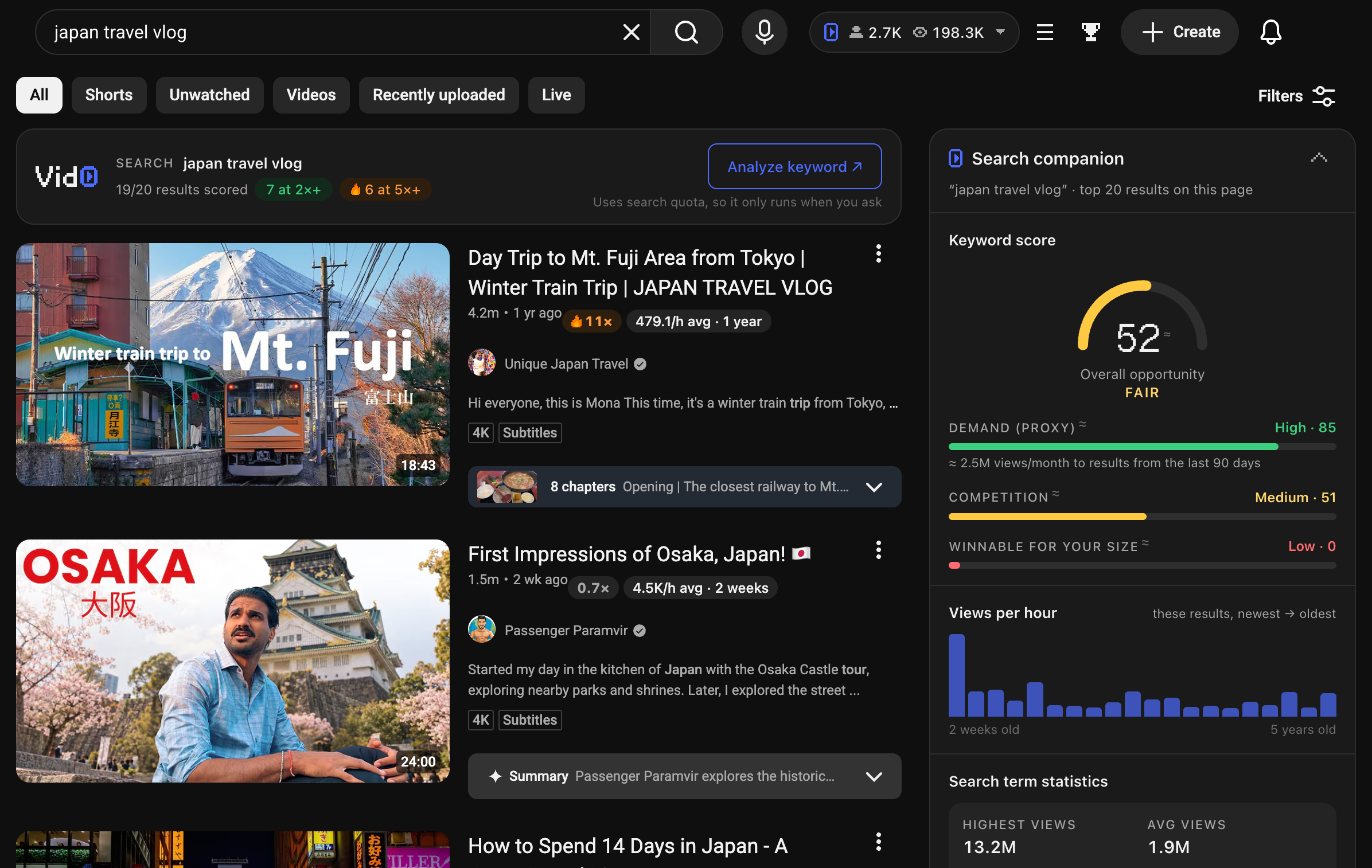
High demand with nobody your size ranking is a trap. Medium demand where small channels already win is where you grow. More on this in YouTube keyword research for small channels.
4. Give people a reason to subscribe
Nobody subscribes to a video. They subscribe to the next one, and they only do it when they can predict it'll be good for them.
So build one or two repeatable formats instead of 30 one-off topics:
- "[Tool] for beginners in 10 minutes"
- "Every [thing] ranked, worst to best"
- "I built [thing] for $0"
Make five to ten videos in a format before you judge it. End each one by pointing at the next video in the series, not with a generic "please subscribe".
5. Write the title and thumbnail before you film
The title and thumbnail are the only parts of the video most people ever see. Settle them first, so the video delivers on a promise you've already made.
- One specific promise. Numbers, names and timeframes make it believable.
- The payoff in the first 40 or so characters, because phones cut long titles off.
- One idea per thumbnail, adding to the title instead of repeating it.
If you can't write a title you'd click yourself, the idea isn't ready yet. Once the video is live, YouTube's Test & Compare can run up to three titles or thumbnails against each other on a long-form video, and it picks the winner by watch time, not clicks. The six-point checklist is in how to write YouTube titles that get clicked, and the free YouTube title checker shows where phones cut your title as you type.
6. Win the first 30 seconds
YouTube Studio's key moments for audience retention report has an Intro figure for every video: the share of viewers still watching after 30 seconds. Your opening decides most of it.
- Confirm the promise. Show the thing the title promised, straight away.
- Say what they'll have by the end.
- Start. No long greeting, no channel intro, no "before we begin".
Then read the retention graph. A dip is where people skipped or left, so tighten whatever sits just before it in your next script.
7. Judge each video against your own usual
At 200 subscribers, comparing yourself with other channels tells you nothing. Compare each upload with your own typical views at the same age, and check three things once a week:
- Click-through rate: is the packaging working? YouTube's page on impressions and CTR says half of all channels and videos sit between 2% and 10%. Here's how to judge yours.
- The Intro figure: is the opening keeping the promise?
- Traffic sources: are people finding you through search, browse or suggested videos?
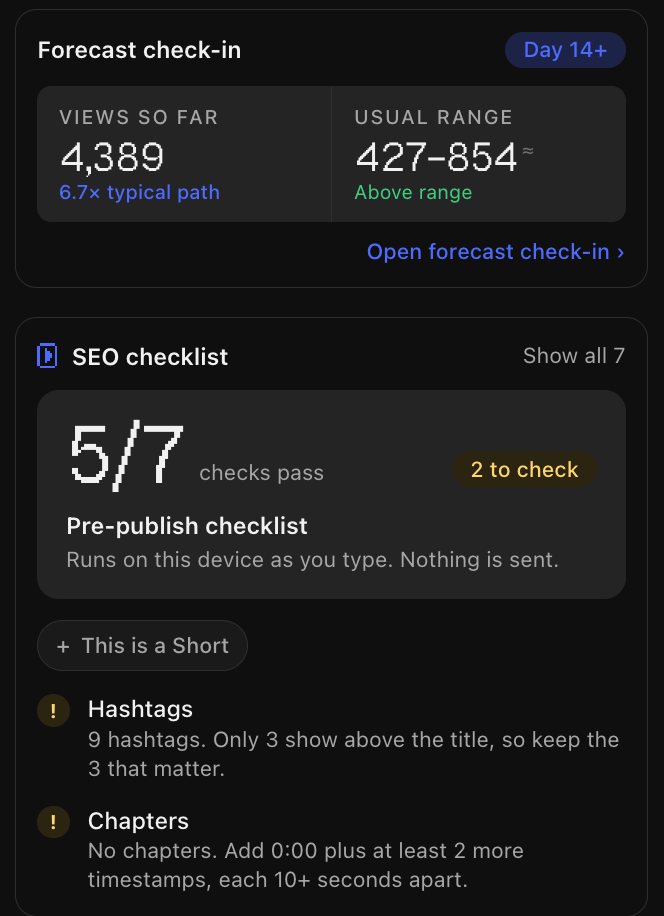
When a video beats your usual by 2× or more, make the follow-up on purpose within two weeks. When one misses, change one thing next time (the topic, the format or the packaging), not all three, so you learn which one it was.
8. Turn comments into the next video
Your first hundred commenters are telling you what to make. Sort their comments into questions, video requests, what they loved and what annoyed them. A question asked by five different people is a video. There are more places to look in where to find YouTube video ideas.
Reply to every comment in the first day. At this size, it's how strangers become regulars.
9. Use Shorts to test, long-form to keep
Shorts are cheap reach and a fast way to test a hook. Long-form is where viewers learn your format and decide to subscribe. Cut the strongest 20 to 40 seconds of each long video into a Short and link it to the full version.
Two things to know: YouTube's Partner Program page says watch hours from Shorts views in the Shorts feed don't count toward the 4,000 watch hours, and a Short should be judged against your other Shorts, not your long videos.
10. Keep a pace you can hold for a year
Upload count matters less than people think. Among the 246 large channels Vid0 tracks, the number of uploads had almost no relationship with subscriber count (the numbers are in what the biggest YouTube channels have in common). One good video a week, or every two weeks, beats a month of daily uploads followed by silence. To pick the day, use your own best time to post, not a generic chart.
Collabs help once you have a few videos that work. Pick channels about your size whose viewers would like yours; the list from step 2 is your shortlist.
What 1,000 subscribers unlocks
Two thresholds in the YouTube Partner Program, as of November 2026, from YouTube's expanded Partner Program overview and eligibility page:
| Tier | Requirements | What it unlocks |
|---|---|---|
| Expanded YPP (eligible countries) | 500 subscribers and 3 public uploads in the last 90 days, plus 3,000 qualified watch hours in the last 12 months or 3 million qualified Shorts views in the last 90 days | Fan funding (memberships, Super Chat, Super Stickers, Super Thanks) and Shopping |
| Full YPP | 1,000 subscribers plus 4,000 qualified watch hours in the last 12 months or 10 million qualified Shorts views in the last 90 days | Ad revenue sharing and YouTube Premium revenue |
Scroll sideways to see every column.
YouTube's eligibility page also says updates to the program start on February 1, 2027, so check it for the current terms before you apply.
Sponsors don't wait for either milestone. Brands pay for steady views from a clear audience, not a subscriber count. Start with how to get your first YouTube sponsorship, and a free Vid0 creator page gives brands one link with your stats and prices.
Doing the research without the spreadsheet
Steps 2, 3, 5 and 7 are research, and by hand they eat your editing time. That's what we built Vid0 for: outlier scores on any channel, a Winnable score for keywords at your size, a title checker that shows where phones cut your title, and a check-in in YouTube Studio that tells you whether a new upload is beating your usual. Most of it runs right on YouTube through the free Vid0 Chrome extension. For the bigger picture after 1,000, read the full YouTube growth playbook.
FAQ
How long does it take to get 1,000 subscribers on YouTube?
There's no set timeline. Channels that get there sooner usually have a clear viewer, a repeatable format and at least one video that beat their usual by 2× or more. Judge progress by whether your typical views are rising over months, not by the calendar.
How many videos do you need to get 1,000 subscribers?
There's no fixed number. A few videos that beat your usual views by 2× or more do more than dozens of one-offs, which is why studying outliers (step 2) and judging against your own usual (step 7) matter more than upload count.
Do Shorts help you get your first 1,000 subscribers?
They help with reach and with testing hooks quickly. Long-form is usually where viewers learn your format and decide to subscribe, so most new channels keep long-form as the core and use Shorts to point people to it.
Should you buy subscribers or do sub4sub?
No. YouTube's fake engagement policy doesn't allow either, and subscribers who never watch drag down the numbers YouTube uses to recommend your videos: click-through rate and watch time.
What happens when you hit 1,000 subscribers?
You can apply for ad revenue sharing once you also have 4,000 qualified watch hours in the last 12 months, or 10 million Shorts views in the last 90 days. In eligible countries, fan funding opens earlier, at 500 subscribers with uploads and watch hours or Shorts views.
Create your creator profile today
Your stats, rates and past collabs on one link, like vid0.in/@yourchannel. Share it with brands and get booked.
Keep reading
All posts →- GrowthResearch
How to grow your YouTube channel: a practical playbook
A growth playbook for small and mid-size channels: pick a viewer, find proven ideas, package and hold attention, then use Shorts, analytics and collabs.
11 min read
- PackagingAnalytics
What is a good CTR on YouTube? (And how to judge yours)
YouTube says half of channels and videos sit between 2% and 10% CTR. Why niche benchmarks don't hold up, and how to judge CTR against your own channel.
7 min read
- ComparisonsResearch
10 vidIQ alternatives compared (2026): free and paid
10 vidIQ alternatives compared on price, free plans and features, from Vid0 and TubeBuddy to 1of10, ViewStats and OutlierKit, with October 2026 prices.
13 min read
Find your next outlier
Vid0 shows which videos broke out in your niche, why they did, and what you could make next.