What the biggest YouTube channels have in common
Data on the 246 big channels Vid0 tracks: how old they are, how much they upload, views per video by category, and what smaller creators can take from it.

8 min read
Vid0 keeps a hand-picked list of large channels for its YouTube channel rankings. We pulled the public numbers for all of them and looked for patterns. Some of the common advice about growing a channel holds up. Some of it doesn't.
What data is this based on?
The numbers come from Vid0's rankings data, fetched from the YouTube Data API at 03:42 UTC on 18 October 2026: subscribers, lifetime views, public video count, country and creation date for each channel. The category is Vid0's own grouping, because YouTube doesn't give channels one.
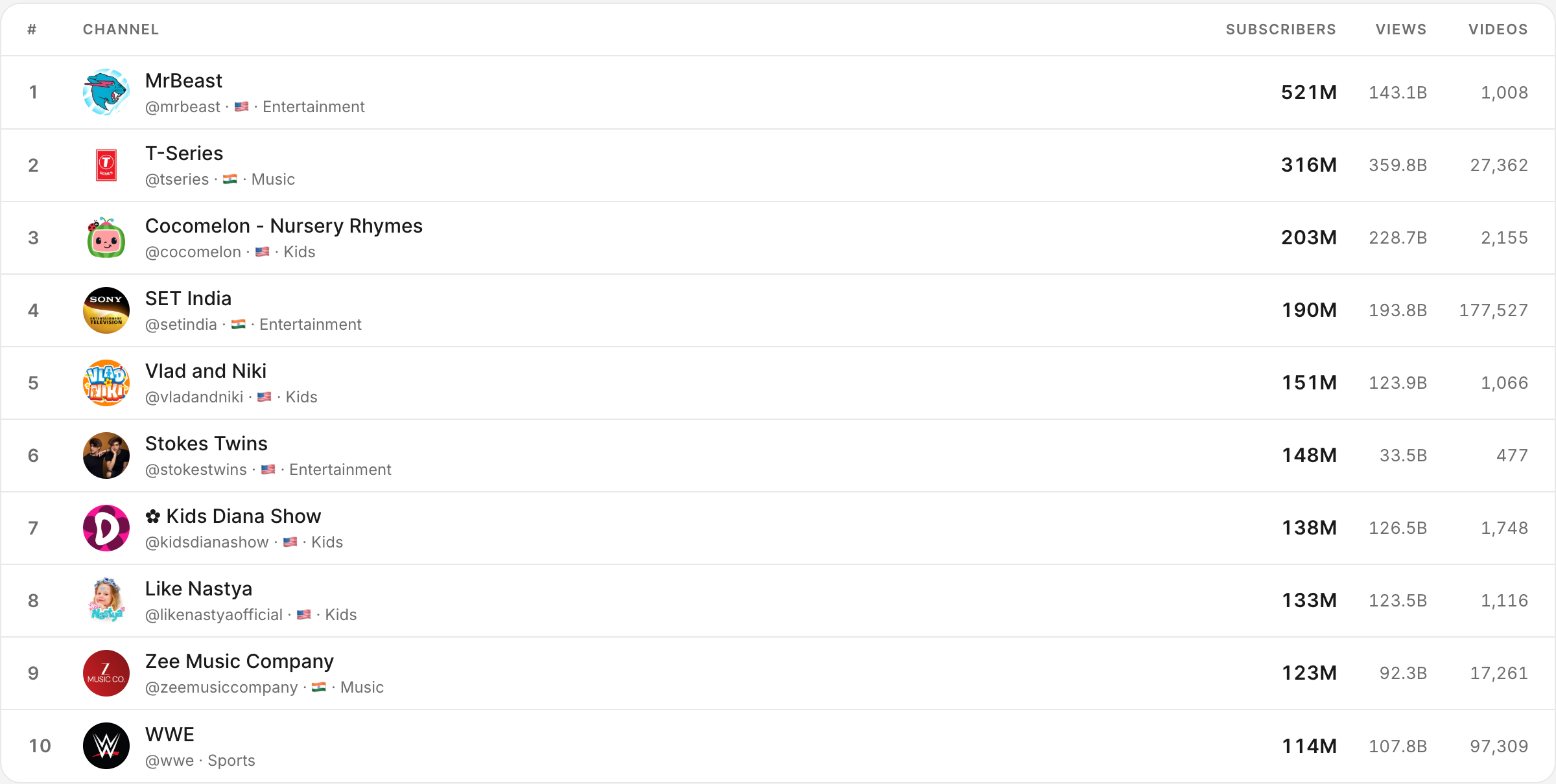
This is not the top 246 channels on YouTube. It's a list Vid0 picks by hand, so it misses some real top channels, and it leans towards the US and India. The rankings methodology explains how channels get in. Read every finding below as "among the 246 channels Vid0 tracks".
Here's how big they are:
| Measure | Lower quartile | Median | Upper quartile |
|---|---|---|---|
| Subscribers | 21.4M | 34.0M | 50.9M |
| Lifetime views | 7.32B | 16.5B | 33.5B |
| Public videos | 607 | 2.4K | 10.5K |
| Views per video | 1.21M | 5.29M | 18.7M |
| Views per subscriber | 270 | 550 | 805 |
Scroll sideways to see every column.
The smallest has 6.2M subscribers. MrBeast, the largest at 521M, holds 4.8% of all the subscribers in the list on his own, and the top 10 channels hold 18.6%.
How old are the biggest YouTube channels?
Old. The median channel was created 14.8 years ago, and 216 of the 246 (87.8%) are at least 10 years old.
| Channel created | Channels | Share |
|---|---|---|
| 2005 to 2009 | 94 | 38.2% |
| 2010 to 2014 | 93 | 37.8% |
| 2015 to 2019 | 54 | 22.0% |
| 2020 or later | 5 | 2.0% |
Scroll sideways to see every column.
The five newest are UR · Cristiano (2024, 83.5M subscribers), Shorts Break (2021), ZHC Crafts, MrBeast Gaming and Alan's Universe (all 2020). Only UR · Cristiano is under 5 years old. Three of the five are new or second channels from people who already had large audiences elsewhere: Cristiano Ronaldo, MrBeast and ZHC. The oldest channels in the list, Marvel Entertainment and Apple, were both created in June 2005.
Young channels that made the list did grow faster per year. The rank correlation between channel age and subscribers gained per year is -0.38. That's partly selection: a young channel can only be in a list of 6M+ channels if it grew quickly.
Do the biggest channels upload more?
Not in any way that tracks their size. The number of public videos ranges from 67 (Galinha Pintadinha, 39.5M subscribers) to 759,302 (Aaj Tak, 75.7M), and a third of the channels (82) have fewer than 1,000 videos.
The Spearman rank correlation between video count and subscribers is -0.02: effectively none. Uploads per year since creation give the same result (-0.02). Leaving out news channels, which upload far more than anyone else, doesn't change it (0.01).
Split the channels into four equal groups by how many videos they have, and the median subscriber count barely moves:
| Public videos | Channels | Median subscribers | Median views per video | Median lifetime views |
|---|---|---|---|---|
| 67 to 605 | 61 | 33.4M | 36.1M | 12.1B |
| 606 to 2,334 | 62 | 44.0M | 11.0M | 12.1B |
| 2,366 to 10,189 | 61 | 31.1M | 3.19M | 15.6B |
| 10,654 to 759,302 | 62 | 34.4M | 339K | 25.4B |
Scroll sideways to see every column.
This doesn't prove that uploading more has no effect on any one channel. It shows that in this group, channels reached the same size with wildly different volumes.
Does posting more mean fewer views per video?
Yes, strongly, in this data. The rank correlation between video count and views per video is -0.86. In the table above, median views per video fall from 36.1M in the lowest-volume group to 339K in the highest.
Total views lean the other way, but weakly. The correlation between video count and lifetime views is 0.27, and the highest-volume group has the most lifetime views (median 25.4B). High-volume channels get there through many videos with modest views each. Low-volume channels get there through a few huge ones.
Views per video here is lifetime views divided by the current public video count. A channel that deleted or hid old videos will look better on this measure than it really is.
Which categories get the most views per video?
Category matters more than anything else in the data. These are medians within each of Vid0's categories:
| Category | Channels | Median subscribers | Median videos | Median views per video | Median views per subscriber |
|---|---|---|---|---|---|
| Music | 50 | 42.4M | 668 | 39.7M | 683 |
| Kids | 24 | 46.4M | 1,985 | 18.4M | 827 |
| Comedy | 8 | 26.7M | 286 | 16.7M | 188 |
| Gaming | 29 | 34.6M | 2,662 | 4.53M | 323 |
| Entertainment | 67 | 37.0M | 3,644 | 3.90M | 547 |
| Lifestyle | 5 | 28.3M | 657 | 3.41M | 164 |
| Education | 12 | 25.5M | 1,718 | 1.94M | 221 |
| Food | 6 | 18.6M | 2,028 | 1.90M | 270 |
| Tech | 8 | 21.3M | 2,253 | 1.80M | 217 |
| Film & TV | 5 | 33.7M | 9,472 | 1.55M | 349 |
| Sports | 16 | 22.3M | 10,730 | 739K | 515 |
| News | 16 | 27.2M | 368,472 | 70.8K | 742 |
Scroll sideways to see every column.
Music videos get rewatched for years, so a music channel with a few hundred videos can sit on tens of billions of views. News is the opposite: the 16 news channels hold 58.6% of all the videos in the list, and a median news video has 70.8K views. Kids channels get the most views per subscriber. Our guess is replays: children watch the same songs and episodes again and again.
Several categories have fewer than 10 channels, so treat their medians as rough. Inside a category the volume trade-off still holds: the correlation between video count and views per video is -0.94 for music, -0.90 for entertainment and -0.90 for education.
Where are the biggest channels from?
| Country set on the channel | Channels | Share |
|---|---|---|
| United States | 75 | 30.5% |
| India | 55 | 22.4% |
| None set | 29 | 11.8% |
| United Kingdom | 13 | 5.3% |
| Brazil | 12 | 4.9% |
| South Korea, Indonesia | 6 each | 2.4% each |
Scroll sideways to see every column.
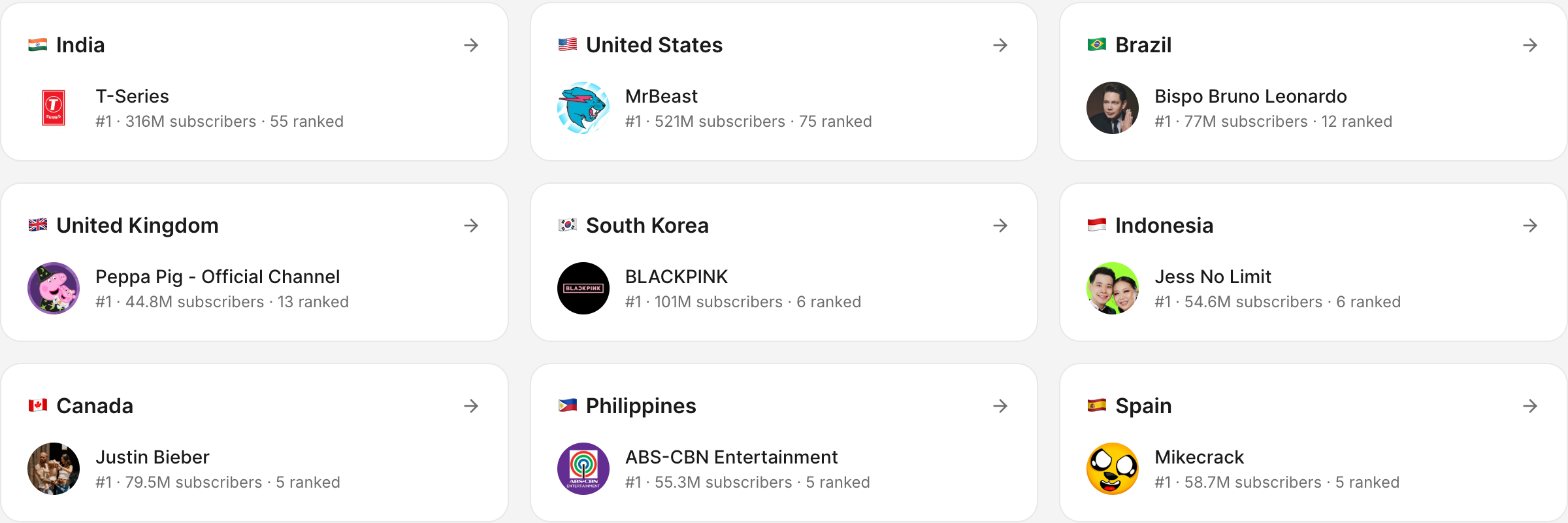
30 countries appear in total. The mix reflects how the list was picked as much as YouTube itself, so don't read it as a global market share.
The Indian and American channels look different. The median Indian channel has more subscribers (36.9M against 34.8M) but far fewer views per video (1.88M against 12.4M). A big part of that is what's in each group: 9 of the 55 Indian channels are high-volume news channels, while the US group has 16 kids channels. You can browse the biggest Indian channels Vid0 tracks and the news channel ranking to see the individual numbers.
Subscribers and views don't move together
Subscribers and lifetime views are related (rank correlation 0.68), but the ratio varies a lot. The median channel has 550 lifetime views per subscriber. Fischer's, a Japanese entertainment channel, has 2,512. UR · Cristiano has 20, because it gained 83.5M subscribers in about two years, faster than views could pile up. Subscriber count alone is a poor guide to how many people actually watch.
What does this mean for a small channel?
- Plan for years, not months. Almost every channel here took a decade or more. If a channel this size can take 15 years, a slow first year isn't a verdict on yours.
- Don't treat volume as the strategy. Big channels exist at every upload rate. What changes with volume is views per video, so pick the rhythm that suits your format and keeps quality up.
- Compare yourself within your category. A 2M-view video is ordinary for a big music channel and huge for a big tech channel. The same is true at small sizes, which is why Vid0 scores every video against its own channel's usual views. The method is in how to find outlier videos on YouTube.
- Watch views, not just subscribers. Views per subscriber ranges from 20 to over 2,500 in this list. Views are what brands and ad revenue follow.
For what to do this week on a much smaller channel, see how to grow your YouTube channel.
FAQ
Are these the 246 biggest YouTube channels?
No. They're the 246 channels in Vid0's hand-picked rankings list, all with at least 6.2M subscribers. Some real top channels aren't in it. The methodology page explains how channels are chosen.
Does uploading more videos get you more subscribers?
Not in this data. Among the 246 channels Vid0 tracks, the rank correlation between video count and subscribers is -0.02. Channels with 67 videos and channels with 700,000 reached similar sizes.
How old is the average big YouTube channel?
The median channel in Vid0's list was created 14.8 years before 18 October 2026. Only 5 of the 246 were created in 2020 or later.
Which YouTube category gets the most views per video?
Music, with a median of 39.7M views per video, then kids at 18.4M. News has the lowest at 70.8K, because news channels publish hundreds of thousands of videos.
How often is this data updated?
The rankings refetch YouTube's public numbers every 6 hours. The figures in this post are from 18 October 2026. Vid0 keeps only 30 days of daily totals, so long-term trends aren't covered here.
Create your creator profile today
Your stats, rates and past collabs on one link, like vid0.in/@yourchannel. Share it with brands and get booked.
Keep reading
All posts →- ResearchGrowth
How to find YouTube video ideas: 9 methods that work
Nine ways to find YouTube video ideas, from outliers and search suggestions to your own past winners, and how to check an idea before you film it.
10 min read
- GrowthResearch
How to get your first 1,000 YouTube subscribers
Ten steps for new channels. Learn from channels your size, package before you film, win the first 30 seconds and judge every upload against your usual.
8 min read
- GrowthResearch
How to grow your YouTube channel: a practical playbook
A growth playbook for small and mid-size channels: pick a viewer, find proven ideas, package and hold attention, then use Shorts, analytics and collabs.
11 min read
Find your next outlier
Vid0 shows which videos broke out in your niche, why they did, and what you could make next.