How much do Indian YouTubers earn per 1,000 views?
RPM vs CPM, why Indian audiences usually pay less per view, how Shorts revenue sharing works, and how to find your real rate in YouTube Studio.

7 min read
Search this question and you'll find dozens of rupee figures that don't agree and rarely say where they came from. This post sticks to what YouTube documents, one dated data point we could check, and how to find your own number.
What's the difference between RPM and CPM?
YouTube defines both on its ad revenue analytics help page:
| RPM (revenue per mille) | CPM (cost per mille) | |
|---|---|---|
| Who it's for | You, the creator | Advertisers |
| What it measures | Your total revenue per 1,000 views | What advertisers pay per 1,000 ad impressions |
| Revenue share | After YouTube's share | Before YouTube's share |
| Which views count | All views, including ones with no ads | Only views where ads ran |
| What it includes | Ads, YouTube Premium, memberships, Super Chat, Super Stickers | Ads and YouTube Premium |
Scroll sideways to see every column.
RPM is the number that tells you what you earn. YouTube's page says RPM is lower than CPM because it's calculated after YouTube's revenue share and includes views that weren't monetized. A quoted CPM is not your earnings.
How much of the ad money does YouTube keep?
The shares are set out in YouTube's partner earnings overview:
- Long-form ads: you get 55% of net revenue from ads on your public videos on the watch page.
- Shorts Feed ads: you get 45% of the revenue allocated to you from the Shorts Creator Pool (more on that below).
- Memberships, Super Chat, Super Stickers and Super Thanks: you get 70% of net revenue.
Why can Indian channels earn less per 1,000 views?
Mostly because of who's watching. YouTube's help page lists the main reasons CPMs move:
- Viewer geography. Advertisers choose which countries to reach, and ad competition differs by location, so "CPMs will vary by geography".
- Time of year. Advertisers bid more at some times than others, and YouTube notes that many bid higher just before holidays.
- Ad formats. Different ad types carry different CPMs. YouTube's suggestions for raising RPM include turning on monetization for all videos and turning on mid-roll ads.
- Unmonetized views. RPM counts every view. If more of your views carry no ads, your RPM falls even when revenue stays the same.
We found no official YouTube figure for India. One dated data point: in a December 2023 post, vidIQ reported that its own channel earned an average CPM of $1.36 from viewers in India and $18.88 from viewers in the US. That's one channel's CPM, not an RPM and not an Indian average, but it shows the size of the difference.
The same post shows topic working through audience. According to vidIQ, its video about the YouTube algorithm had a CPM of $20.67 because more US viewers watched it, while one about gaining subscribers sat at $1.13 because more viewers were in India. Your niche matters partly because it decides who watches.
We found no reputable, current source for typical Indian RPM ranges, so we're not quoting one.
How do YouTube Shorts earnings work?
YouTube's Shorts monetization policies describe a pooled model:
- Each month, revenue from ads between videos in the Shorts Feed is added together.
- Part of it goes to music partners when Shorts use music (half of a Short's share if it uses one track). The rest forms the Creator Pool.
- The pool is split by each creator's share of engaged views from monetizing creators in each country.
- You keep 45% of what's allocated to you, whether or not you used music.
YouTube's own example: if a country earns $100,000 in Shorts Feed ad revenue and the pool after music is $90,000, a creator with 1% of the engaged views is allocated $900 and keeps $405.
Because the pool is split by country, Indian Shorts views share revenue from ads shown in India. And the bar is going up: the same page says that from 1 February 2027, you'll need at least 10 million qualified Shorts views in the last 90 days to get a share of Shorts ad and Premium revenue for a month. For comparison, the Partner Program eligibility page asks for 1,000 subscribers plus either 4,000 watch hours in 12 months or 10 million qualified Shorts views in 90 days.
How do you find your own RPM in YouTube Studio?
- Open YouTube Studio and select Analytics in the left menu.
- Select Revenue at the top. According to YouTube's guide to checking your revenue, the content performance report there shows your RPM, split by videos, Shorts and live streams, and the "How you make money" report splits revenue by source.
- To see which countries earn the most, open Advanced mode and break the report down by geography with revenue metrics added. YouTube's Advanced mode guide covers the breakdowns.
- Look at Shorts and long-form separately. A blended number hides what each format brings in.
These are estimates. YouTube adjusts them after about a week and again mid-month, and finalized earnings appear in AdSense for YouTube. YouTube has also been rolling out a new Studio layout since July 2026, so your screens may differ.
A worked example (illustration only)
Assumptions: a channel gets 40,000 views on long-form videos and 300,000 views on Shorts in a month. We use Vid0's generic RPM ranges from its Chrome extension, $1 to $5 per 1,000 long-form views and $0.03 to $0.08 per 1,000 Shorts views, and convert at ₹94.96 per US dollar. That rate is derived from the European Central Bank's reference rates for 16 October 2026 (₹106.864 and $1.1253 per euro).
| Views | RPM range (USD) | Estimate (USD) | Estimate (INR) | |
|---|---|---|---|---|
| Long-form | 40,000 | $1 to $5 | $40 to $200 | ₹3,798 to ₹18,992 |
| Shorts | 300,000 | $0.03 to $0.08 | $9 to $24 | ₹855 to ₹2,279 |
| Total | 340,000 | $49 to $224 | ₹4,653 to ₹21,271 |
Scroll sideways to see every column.
The arithmetic is views ÷ 1,000 × RPM. For long-form, that's 40 × $1 = $40 and 40 × $5 = $200.
Two caveats. These ranges aren't India-specific, and a mostly Indian audience can land at the low end or below it. And at 300,000 Shorts views a month, this channel would fall short of the 10 million views per 90 days YouTube will require for Shorts ad revenue from February 2027. For real numbers, swap in the RPM from your Studio Revenue tab.
How does Vid0 estimate a channel's earnings?
Vid0's Chrome extension shows an "est. earnings · 30d" tile on channel pages. It takes the views on videos uploaded in the last 30 days and multiplies them by the same generic ranges as above: $1 to $5 per 1,000 long-form views and $0.03 to $0.08 per 1,000 Shorts views.
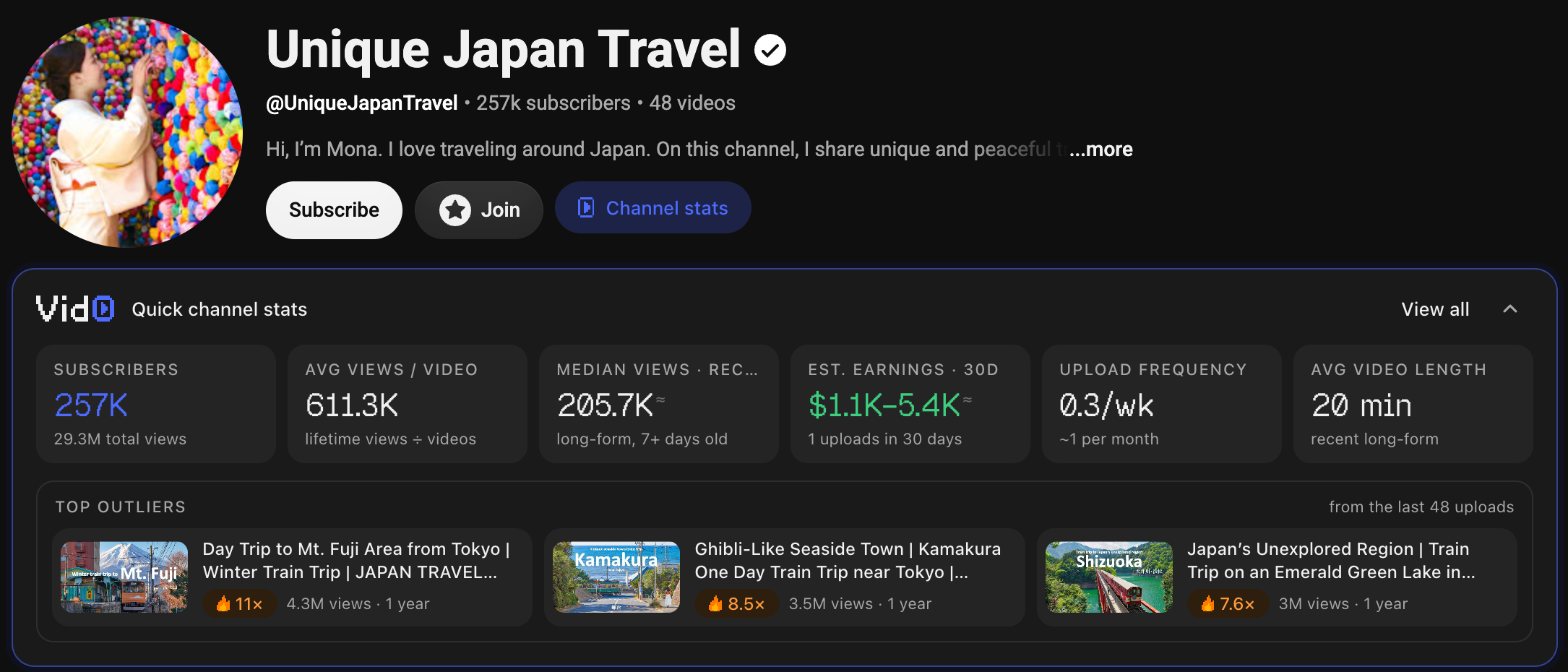
The ranges are deliberately wide, in US dollars and not India-specific. They don't know a channel's audience country, niche or Shorts eligibility, so they can run high for India-heavy channels. Use the tile to compare channels roughly, not to predict a payout. More on the Vid0 Chrome extension.
How else do Indian YouTubers earn?
- Brand deals. Sponsors pay per video, not per ad view, and price from your typical views and niche. Our guide to how much to charge for a YouTube sponsorship walks through the formula.
- Channel memberships and Supers. You keep 70% of net revenue. YouTube's ways to earn page lists the memberships threshold: 500 subscribers, 3 public uploads in 90 days, and either 3,000 watch hours on long-form in the last year or 3 million Shorts views in 90 days.
- YouTube Premium revenue and Shopping. Premium subscribers' fees are shared with the channels they watch, and the Shopping affiliate program pays on tagged products.
To estimate what another channel earns, see how to check any YouTube channel's stats and earnings. If you're building a creator business in India, Vid0's plans are priced in rupees, starting with a free plan.
FAQ
How much does YouTube pay for 1,000 views in India?
It varies by channel, with audience country, topic, season and format mix. Check your RPM in YouTube Studio under Analytics, then Revenue.
Why is my RPM lower than my CPM?
RPM is after YouTube's revenue share and counts every view, including ones that showed no ads. CPM is what advertisers paid before YouTube's share, on monetized views only.
Do Shorts pay in India?
Yes, through the Shorts Creator Pool, which is split by engaged views within each country. You keep 45% of your allocation. From 1 February 2027, you'll need 10 million qualified Shorts views in the last 90 days to get a share each month.
Is a US audience worth more than an Indian one?
For ad revenue, usually yes. vidIQ reported a CPM of $18.88 from US viewers and $1.36 from Indian viewers on its own channel in 2023. Sponsorship rates are a separate negotiation between you and the brand, not set by the ad auction.
How many views do I need to earn ₹1 lakh a month?
Divide ₹1,00,000 by your RPM in rupees and multiply by 1,000. At an RPM of ₹100, that's 1,000,000 views. The ₹100 is only for the arithmetic; use your own RPM from Studio.
Create your creator profile today
Your stats, rates and past collabs on one link, like vid0.in/@yourchannel. Share it with brands and get booked.
Keep reading
All posts →- ResearchAnalytics
How to check any YouTube channel's stats and earnings
Which YouTube channel stats are public, how to check them free, and how earnings estimates work, with a worked example and why they can be far off.
7 min read
- AnalyticsOutliers
What is views per hour (VPH) on YouTube? How to read it
What VPH means, how to work it out for any video, the difference between average and live VPH, and why a good VPH depends on the channel.
7 min read
- PackagingAnalytics
What is a good CTR on YouTube? (And how to judge yours)
YouTube says half of channels and videos sit between 2% and 10% CTR. Why niche benchmarks don't hold up, and how to judge CTR against your own channel.
7 min read
Find your next outlier
Vid0 shows which videos broke out in your niche, why they did, and what you could make next.