YouTube influencer marketing cost in 2026: how to budget
How brands can estimate what a YouTube creator should cost: pricing models, a views-based formula, a worked launch budget and what moves the price.

7 min read
Creators with the same subscriber count can get wildly different views, so there's no single price. This post doesn't quote industry-average rate cards. It gives you a method you can check against any creator's public numbers: the one Vid0 uses for creators' suggested rates and brands' fair prices.
What pricing models do YouTube creators use?
| Model | How it works | When it fits |
|---|---|---|
| Flat fee per integration | A set price for a 60 to 90 second segment inside a normal video | The usual starting point |
| Dedicated video | A whole video about your product | Launches and complex products that need a demo |
| YouTube Short | A sponsored Short, or a segment in one | Reach and awareness, cheaper per video |
| CPM-based | A price per 1,000 views, usually with a cap | When you want to pay for what the video actually reaches |
| Performance or affiliate | A commission per sale or sign-up, tracked by a code or link | Products that convert online. Often combined with a smaller flat fee |
| Add-ons | Usage rights, exclusivity, a pinned comment, a link in the description, a community post | Priced on top of the main deliverable |
Scroll sideways to see every column.
Flat fees are the easiest to plan around, so the useful question is what flat fee is fair.
How do you estimate a fair price from a creator's views?
Start from the creator's typical views per long-form video, not their subscribers. Vid0 uses the median views of the channel's recent long-form uploads that are at least 30 days old. The median ignores one-off hits. If fewer than three videos are 30 days old, Vid0 falls back to videos at least 7 days old and flags the number as a likely underestimate.
Then multiply (or let the free YouTube sponsorship rate calculator do it):
Integration price = typical views ÷ 1,000 × the niche's CPM band
These are the bands Vid0 uses. They are Vid0 estimates, not data from YouTube or from any brand:
| Niche | CPM band (USD) |
|---|---|
| Finance | $40 to $80 |
| Tech | $30 to $60 |
| Education | $20 to $45 |
| Lifestyle | $15 to $35 |
| Gaming | $10 to $25 |
| Other / general | $15 to $50 |
Other formats scale from the integration price: a dedicated video at 1.3× to 3×, and a Short at 0.3× to 0.6×. Vid0 rounds prices to $5 steps under $100, $10 steps under $1,000 and $50 steps above. The creator-side version of this, with worked examples at 5K, 20K and 100K views, is in how much to charge for a YouTube sponsorship. The numbers here match it.
Why does the median matter so much?
Because the average can be several times higher. Here's a real travel channel with Vid0's quick stats on its YouTube page:
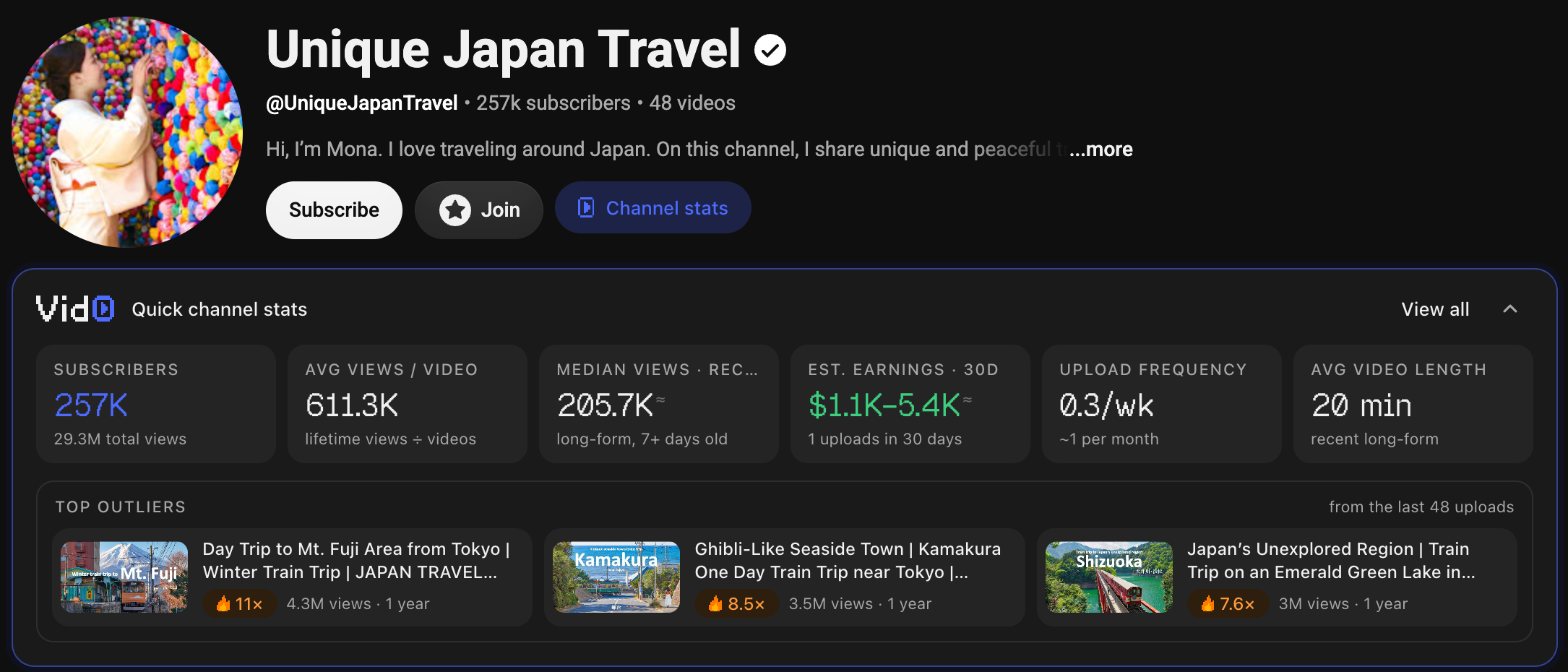
Treat travel as Lifestyle ($15 to $35) for the sake of the example:
- On the median (205.7K): 205.7 × $15 = $3,085.50 and 205.7 × $35 = $7,199.50, rounded to $3,100 to $7,200.
- On the average (611.3K): 611.3 × $15 = $9,169.50 and 611.3 × $35 = $21,395.50, rounded to $9,150 to $21,400.
Price on the average and you pay about three times as much for the views a typical video gets. The panel's median uses videos 7 or more days old, while Vid0's price estimate uses 30 or more, so the real estimate for this channel could differ. The point stands either way: budget on the median.
A worked example: budgeting a $5,000 launch
Say you're launching a note-taking app for students and developers (Tech band, $30 to $60) with $5,000. You shortlist three creators whose audiences fit. The creators are made up. The maths is the formula above.
| Creator | Typical views | Integration range | Midpoint |
|---|---|---|---|
| A, a small study channel | 8,000 | $240 to $480 | $360 |
| B, a mid-size productivity channel | 25,000 | $750 to $1,500 | $1,125 |
| C, a larger developer channel | 60,000 | $1,800 to $3,600 | $2,700 |
| Total | 93,000 | $2,790 to $5,580 | $4,185 |
Scroll sideways to see every column.
Budget on the midpoints: $4,185 for about 93,000 expected views, or about $45 per 1,000 views ($4,185 ÷ 93,000 × 1,000). That leaves $815 for one more small creator or an add-on like usage rights.
If creator B suits a full demo better, here's what each format would cost:
| Creator B format | Multiplier | Range |
|---|---|---|
| Integration | 1× | $750 to $1,500 |
| Dedicated video | 1.3× to 3× | $980 to $4,500 ($750 × 1.3 = $975, rounded) |
| Short | 0.3× to 0.6× | $230 to $900 ($750 × 0.3 = $225, rounded) |
Scroll sideways to see every column.
What raises or lowers a creator's price?
Where a creator lands inside the range depends on:
- Audience fit. A small audience that trusts the creator on your exact topic is worth more to you than a broad one.
- Proof. Creators with results from past deals (sign-ups, sales, codes used) can fairly ask for the top of the range.
- Usage rights. Reusing the creator's clip in your own ads is a separate fee. Agree how long and where.
- Exclusivity. Asking a creator not to work with competitors for a period costs extra.
- Timing. Rush deadlines and fixed publish dates around a launch can cost more. Flexible timing can cost less.
- Extras. A pinned comment, a link in the description or a community post are priced separately. Vid0's creator pages start these at $80 for a pinned comment with a link for 30 days, $60 for a link in the description for 30 days and $100 for a community post, and creators change them.
- Volume. A series of videos with one creator can be cheaper per video than one-offs. Ask.
Flat fee or CPM: which should you pay?
With a flat fee you carry the risk that a video underperforms, which is why pricing on the median matters. A CPM deal moves that risk to the creator, so they may ask for a higher rate per 1,000 views, and you'll want a cap. For a launch with a fixed date, flat fees are easier to plan. Once you know which creators convert, CPM or a flat fee plus a performance bonus can make sense.
How does Vid0 price creators for brands?
On Vid0 for brands, every matched creator shows expected views and a price. The price is the creator's own rate card if they've set one, or a Vid0 estimate from the formula above if they haven't. The campaign planner takes a budget, a goal and the creator sizes you want, and suggests creator mixes that fit the budget, using the midpoint of each price, like the worked example. Every number is a Vid0 estimate. The Vid0 team confirms rates and timing with each creator before anything is booked. Brand search limits for each plan are on Vid0 pricing.
For the full shortlisting process, see how to find YouTube creators for a product launch.
FAQ
How much does it cost to sponsor a YouTuber?
It depends on views and niche. With Vid0's formula, a 60 to 90 second integration costs typical views ÷ 1,000 × the niche's CPM band. A tech creator at 20,000 typical views comes to about $600 to $1,200.
How much does a YouTuber with 100K subscribers charge?
Subscribers don't set the price. A 100K-subscriber channel whose videos usually get 10,000 views prices like a 10,000-view channel: about $300 to $600 for an integration in tech, or $150 to $350 in lifestyle.
Is a dedicated video worth it compared with an integration?
For a product that needs a demo, often yes. Vid0 prices a dedicated video at 1.3× to 3× the integration, because it takes more work and gives you the whole video.
How much do YouTube Shorts sponsorships cost?
Vid0 prices a Short at 0.3× to 0.6× the integration price. Shorts are cheaper per video, but views on Shorts are harder to turn into clicks.
Do creator prices include usage rights?
Usually not. Reusing a creator's clip in your ads, or asking them to avoid competitors for a period, is agreed and priced separately.
Create your creator profile today
Your stats, rates and past collabs on one link, like vid0.in/@yourchannel. Share it with brands and get booked.
Keep reading
All posts →- For brandsBrand deals
How to find YouTube creators for a product launch
A step-by-step way for brands to shortlist YouTube creators for a launch, judge them on median views and fit, pitch them and get disclosure right.
7 min read
- Brand dealsPricing
How much to charge for a YouTube sponsorship (with the formula)
The formula Vid0 uses to price a YouTube integration from your typical views and your niche, with worked examples at 5K, 20K and 100K views.
6 min read
- IndiaComparisons
The best YouTube tools for Indian creators (2026)
Free YouTube Studio tools, then Vid0, vidIQ, Kolliq, Tubelyzer, AuditTube, TubeBuddy, 1of10 and ViewStats compared for Indian creators, with rupee prices.
7 min read
Find your next outlier
Vid0 shows which videos broke out in your niche, why they did, and what you could make next.